3 Steps to Help Kids Enjoy Piano Practice

If your child has ever sighed at the words ‘practice time,’ you’re not alone. I know you want your kids to enjoy music, not resent it, but it’s not always as easy as telling them to clean their room. However, with the right mindset and small adjustments, practice can become a source of confidence and creativity. In this article, you will learn 3 simple steps to help your child enjoy piano practice and look forward to making music.
Step 1: Start Small — Make Practice Feel Doable
The first step to helping your children enjoy piano practice is to start small. Consistency beats length. Even if your child only practices for 5 focused minutes, it matters. At Morse Music Academy, we don’t focus on timed practice. I give students a practice goal every week that sounds something like this, “Practice all assigned songs and exercises for 4 days this week. Each day, practice each song/exercise 2 times.” I find that practice feels more doable that way. Small, confident steps lead to lasting growth.

Step 2: Build Connection Before Correction
In order to help your child enjoy practice, connecting with them is key. Just like with anything, you catch more flies with honey than vinegar. Kids thrive on feeling understood, not pressured. Here’s a helpful tip: ask your child what they like about playing piano before jumping in with demands. Encouragement builds motivation. I am intentional about using kind, encouraging words throughout the lessons I teach. A little kindness and connection goes a long way.

Step 3: Make It Musical — Bring Play Back to Practice
The final step to helping your children enjoy piano enjoy piano practice is play. Fun is a powerful teacher. There was a study done about learning. In this study they found that in order to learn something new, you have to repeat it over 200 times. However, when learning something new through play, you only have to repeat it 12 times! I use lots of reinforcement games and activities in my lessons. Some other ideas of fun could be improvisation, playing duets, and performance, all of which I also incorporate into my lessons. Encouraging creative play is what builds both joy and confidence.

Piano practice isn’t just about repetition – it’s about discovery, growth, and confidence. You can make a big difference just by showing interest and celebrating effort. If you’d like more ways to help your child enjoy their musical journey, download my free parent guide First Notes to Confidence: A Parent’s Guide to Musical Growth. It includes a simple song and reflection activity to start your child’s piano journey on the right note. Comment GUIDE below to download it!

Or, click here to download 5 fun practice trackers to keep your child motivated to practice!

Why Piano Builds Creativity, Confidence, and Commitment

These days, parents want their children involved in activities that go beyond “just another hobby”. They want ones that their kids can use later in life and ones help build skills that last a lifetime. Piano isn’t only about music — it shapes kids’ creativity, confidence, and commitment that goes beyond the piano bench and translates to regular life.

Piano Builds Creativity
A large part of music is self-expression. In piano lessons, students participate in improvisation, composition, and trying out new songs and sounds. All of these things foster creativity in students. Studies show that piano strengthens connections between brain hemispheres which boosts problem-solving and imagination. Lots of times in my teaching, students have pressed a wrong note or played a passage incorrectly and actually loved the way it sounded which created a “mini-composition”. I also currently have a sweet student who composed her own version of Twinkle, Twinkle Little Star. So much creativity!

Piano Builds Confidence
Piano lessons teach success in small steps: playing a first song, learning to read notes, performing at recital. With each step, students build confidence. When students perform at recital, they take leaps in confidence. Kids beam when they realize “Oh, I CAN do this!” Research shows that self-esteem is boosted when students take music lessons.

Piano Builds Commitment
When students show up daily, even for just 10 minutes, discipline is built. With each step of commitment, long-term progress is grown. From first notes to more complex pieces, persistence pays off. Commitment that is learned at the piano bench is a transferable skill: it applies to school, sports, and personal goals. Students who consistently take piano lessons make great progress, even after just a few months.

The Bigger Picture
Each of these skills — creativity, confidence, and commitment — work together and builds deeper attributes. Creativity fuels joy, confidence fuels courage, and commitment fuels growth. Piano lessons are a safe, supportive environment for kids to develop life skills beyond music. Piano builds more than musicians — it builds strong and resilient kids. Imagine your child thriving in creativity, confidence, and commitment. If you’d like to see how piano can shape your child’s growth, we’d love to welcome you to our studio!

3 Lessons I Learned About Creativity from My Students

Oftentimes, parents think learning to play piano is all about playing the “right” notes. While this is important, and musical literacy is one of the key tenants of our program, it isn’t the only aspect of learning to play piano. Students show me everyday that creativity is just as important. In our piano lessons for kids, one of the key components is creativity in music, and it is one of the benefits, too.

Creativity Starts with Curiosity

There are plenty of times in my many years of teaching that students have changed up parts of songs, and made it even better. Such as, students preferring a different note or two to end on or even thinking the song should be louder or softer than written. I give children space to ask questions and think outside of the box. This sparks ideas in them. When we encourage kids to explore the “what if” in practice, creativity is cultivated.

Mistakes Can Lead to Magic

A wrong note can turn into a brand new melody. Sometimes students make a mistake and actually end up creating something they like better. Mistakes aren’t failures—they’re opportunities to create. At Morse Music Academy, we don’t just praise achievements and completing songs correctly, we also praise effort and experimentation. 

Creativity Grows When Shared

When students are able to collaborate, creativity grows. Sharing with others builds confidence and inspires more ideas. A really great way to practice this is inviting your child to play for friends and family members, or maybe even at your church. We offer two recitals throughout the year so students can grow through performance. 

The three aspects of creativity that I learned from my students are curiosity, resilience, and sharing. Piano lessons at our studio build creativity, confidence, and commitment in ways that last far beyond music. Ready to nurture your child’s creativity? Book a free consultation by commenting below!

5 Ways Piano Teaches Resilience for Real Life

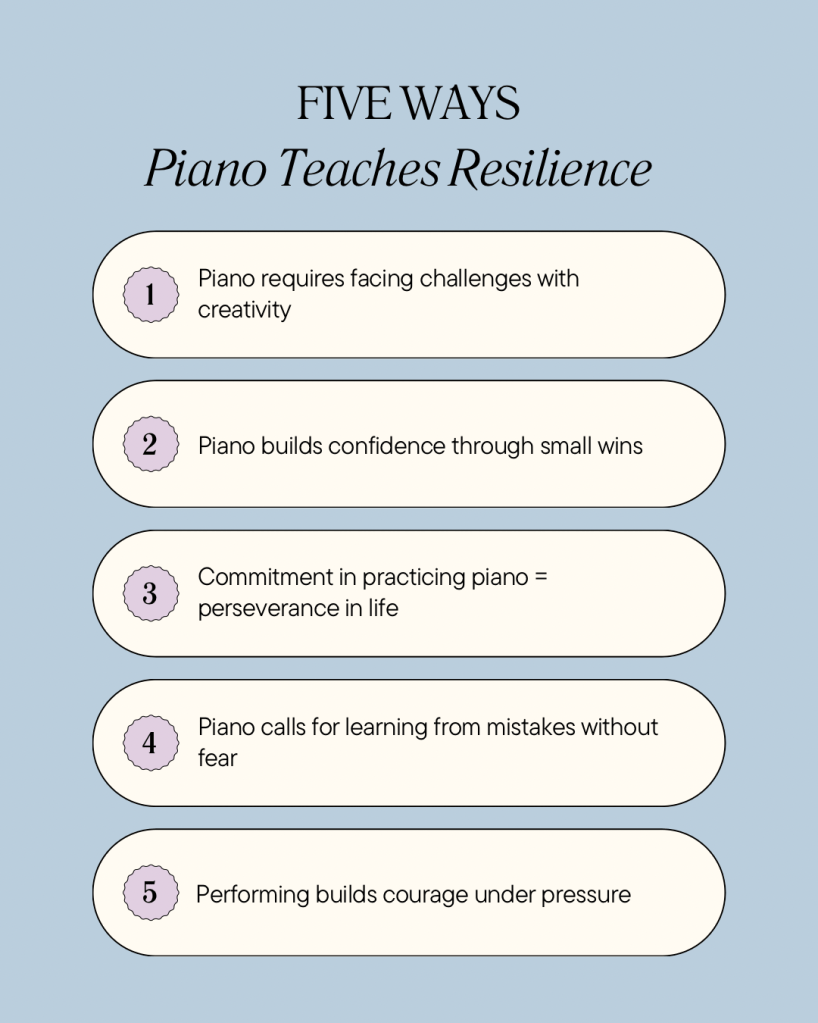
Naturally, parents want their children to succeed. I have a 1 year old, and even though she can’t do much, I still desire her success. Unfortunately, many kids struggle. The problem lies in resilience. In order to succeed, children need resilience. It’s the key to success. What’s true about resilience and success in life is also true in piano lessons. Piano lessons are more than music — they’re a safe space to practice life’s challenges. Students can build resilience through music which translates to regular life. Here are 5 ways piano lessons do just that:

Way 1: Facing Challenges with Creativity
Piano teaches students how to face challenges with creativity. During piano lessons, children learn to solve problems by trying different approaches. When tricky passages in songs come up, I lead students to use creativity when things are challenging by showing them different ways to work on the section. This builds flexible thinking, which is an essential skill when it comes to resilience.

Way 2: Building Confidence Through Small Wins
Piano lessons help build confidence through small wins. Every song that students master is proof to them that hard work pays off. This creates momentum which produces confidence. Confidence grows from consistent effort, not instant success. That’s why piano lessons are so valuable, especially in an instant results saturated world.

Way 3: Commitment in Practice = Perseverance in Life
Piano lessons grow commitment as well. When students are committed to practicing and working on their assigned songs, they grow in perseverance. That same perseverance that’s worked out in the studio translates to regular life. Regular practice teaches discipline and follow through. Even when passages are tricky or scales trip them up, students are encouraged to keep showing up. This produces resilience.

Way 4: Learning from Mistakes Without Fear
Weekly piano lessons teach students how to learn from mistakes without fear. Making mistakes is a normal part of learning music. By practicing making mistakes without worry, students learn to adjust, keep going, and not give up. I don’t ignore mistakes, but I remind them that everyone makes mistakes and they show us what we need to work on to grow. This teaches emotional regulation and fortitude.

Way 5: Performing Builds Courage Under Pressure
Piano lessons provide opportunities for performance which builds courage under pressure. At Morse Music Academy, we have 2 recitals each year. Each student prepares and performs 2 songs. Recitals are the perfect setting for practicing resilience in front of others. They help students face nerves, adapt to challenges, and celebrate progress with peers and parents.

Piano lessons teach resilience through helping students face challenges with creativity, build confidence through small wins, commit to practicing which translates to real life perseverance, learn from mistakes without fear, and build courage under pressure. Give your child the chance to grow stronger both at the piano and in life! Book a free consultation today by commenting below!

What Really Happens in a First Piano Lesson

Many parent (and students!) are curious about what their first piano lesson might be like. First lessons are crucial for explaining studio values, getting to know one another, and helping students and parents feel like they made the right choice in choosing piano lessons, and their specific studio. Below you will find what really happens in a first piano lesson at Morse Music Academy:

Introduction and Questions:
First, I introduce myself and give a quick studio tour. After that, I invite students to sit on the piano bench and ask them a series of questions. Most often I ask get to know you questions, and also musical experience questions. A few of each that I typically ask are “What is your favorite color?”, “How old are you?”, “Have you ever taken music lessons or classes at school?”, “What can you remember from those?”, etc.

Incentive Program:
Next, I explain our incentive program, Music Money. Students can earn coins for completing their practice goal, arriving on time, transposing songs, learning songs not from their book, etc. They can then exchange the coins for trips to my prize box, gift cards, all games lessons, and more. Each student has a jar with their name on it, and they can decorate it with various stickers so we do that as well.

Lesson Book:
After they get their jar decorated, we start working in their lesson book. Most students use Wunderkeys lesson books, but some also use Faber. Typically first units include an explanation of keyboard, finger numbers, and musical alphabet, but concepts vary for each age and starting point.

Game Time:
After they learn something new, we play a game. Games are huge hits at our studio! Oftentimes, I will use a game called Shell Bell which reinforces finger numbers.

Homework and Practice Goal:
At the end of the lesson, I explain and go over what they are expected to work on and practice throughout the week. I give students a practice goal that they can work towards. If they complete it, they can earn coins for the Music Money incentive program. We also add coins to their jar for anything they may have earned.

Talk to Parents:
Finally, I like to explain to parents what we worked on and learned and explain what they need to practice throughout the week. Parental involvement is one of the keys to successful piano lessons.

So, there you have it! This is what really happens in a first piano lesson at Morse Music Academy! Check out our testimonials page to hear from some of our happy parents. If this sounds great to you, comment FIRST below and we can set up an info call to get you enrolled!

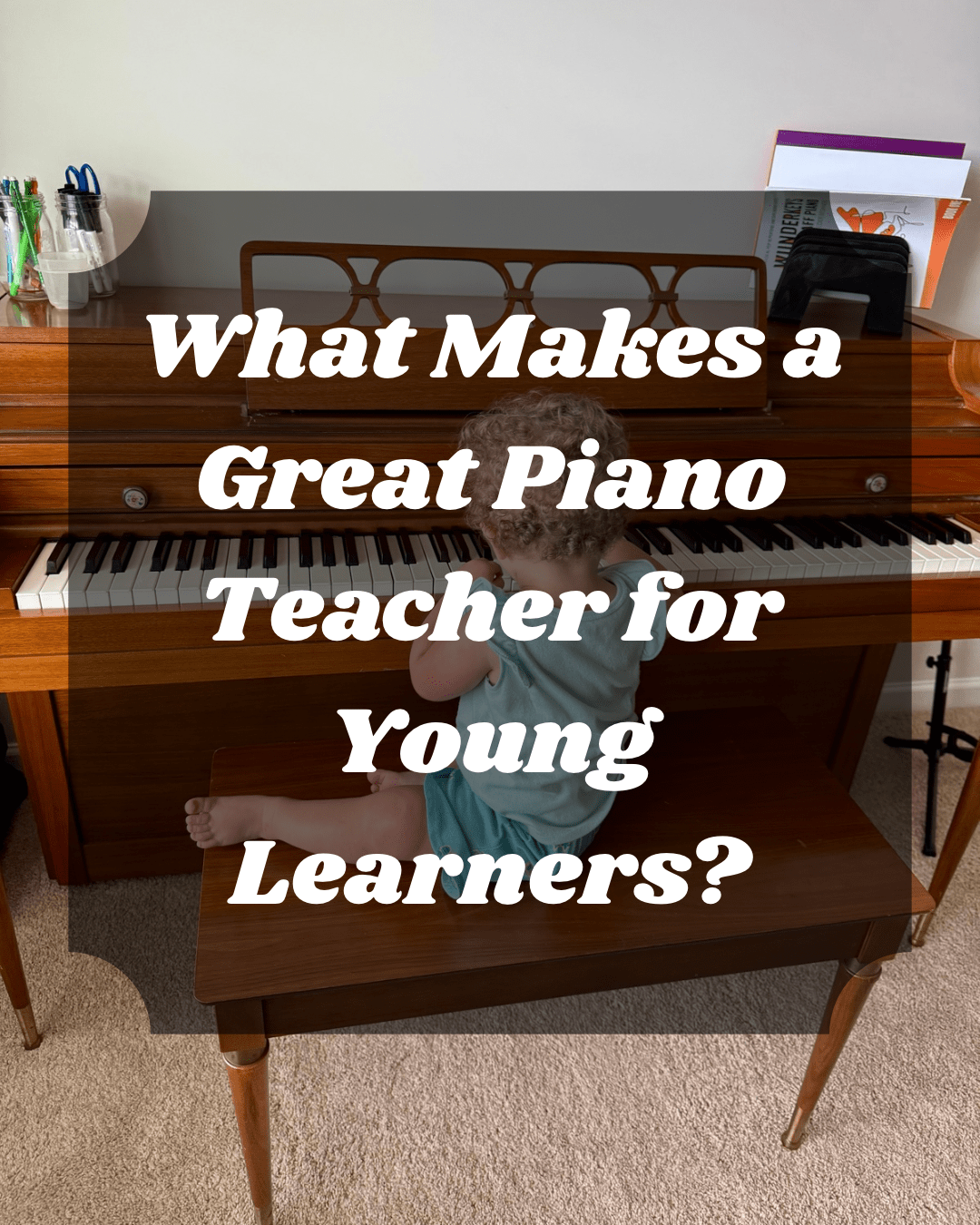
What Makes a Great Piano Teacher for Young Learners?

More than music — the mentor behind the keys.

Many parents wonder: what should I look for in a piano teacher? A lot of parents weren’t trained in piano, so they feel lost about who is qualified and the right one for their child. Piano lessons aren’t just for music credits or the enjoyment of learning to play songs, even though those are great benefits of taking regular lessons. Great teaching goes beyond scales and songs — it’s about developing the whole child. At Morse Music Academy, our focus is on developing and growing creativity, confidence, and commitment in children of all ages and abilities. Here are 5 things that make a great piano teacher for young learners:

1. They Encourage Creativity — Not Just Repetition

A great teacher nurtures imagination and creativity through improv, composition, and play. We use each of these in our lessons as well. We encourage improv by assigning it every few weeks. We also encourage composition. I have two particular students who are actively learning music theory and composition so that they can write their own songs. I also work with another student who loves to compose and improvise, and I assist her through writing down the songs she creates. We also implement play by including reinforcement games in almost every single lesson. Great teachers help children explore their own voice, not just follow instructions. Creative expression fosters a long-term love of music in children because it’s not just about following a set of rules or completing homework anymore. It becomes a place for them to express themselves and learn in a fun and engaging way.

2. They Build Confidence Through Small Wins

Great teachers boost children’s confidence through helping them achieve their goals step-by-step. When teachers use gentle, clear feedback, students feel safe to try and fail. We help students set clear goals and achieve them through small wins which encourage them to keep going. Great teachers celebrate effort and remind their students that perfection is not the goal, growth is. Providing opportunities for performance grows courage over time. At Morse Music Academy, we offer two recitals yearly. These provide a place for students to grow into well-rounded, confident piano players, and also show parents, friends, and others the progress they have made.

3. They Teach Commitment — in Kid-Sized Steps

Great teachers not only encourage creativity and confidence, but they also teach commitment. Even young students can learn to stick it out when they don’t get it right the first time. Consistency and practice are taught as habits, not chores. The right teacher equips students to work through challenges. This is accomplished by playing reinforcement games, encouraging words, and a student-led/personalized approach to learning, all of which are key cornerstones here at Morse Music Academy. This commitment isn’t only for learning piano, however. Although very important for learning to play piano, this commitment spills into their personal lives. You will find a more dedicated school student, a more loyal friend, and a responsibility that follows your child into adulthood.

4. They Know Child Development, Not Just Music Theory

Great teachers also know what is required for children to learn effectively and efficiently. They know that young learners need movement, patience, and play-based learning. That is why a key pillar of lessons at Morse Music Academy is reinforcement games. These games get students moving and off the piano bench, as well as teach them concepts in a fun and engaging way. Great teachers adapt their methods to fit each child’s learning style and goals as well. Learning piano can be both fun and focused this way. The best teachers become mentors who inspire lifelong learning.

Outstanding piano teachers develop both skills and character, like those of creativity, confidence, and commitment. These skills make excellent piano students, and also carry over into their personal lives. When you find a teacher who empowers creativity, confidence, and commitment — your child doesn’t just learn music… they grow. Curious what that looks like in action? Book a free info session at Morse Music Academy by commenting GROWTH below — and see the difference.

Top 5 Ways Music Lessons Improve Emotional Intelligence

How piano builds more than just musical skill

Emotional Intelligence is the art of possessing awareness, regulation, true empathy, and proper social skills. According to an article published on nwnoggin.org, “Children ranging from ages 4 to 5 were found to score higher when measured for empathy and extraversion, and they scored higher on their level of communication if they started group music lessons under the age of 1 years old versus those who started a few months later. This suggests that teaching even the youngest of minds about the art of music while amongst peers, acts to socialize them in a way that would make them more successful in their current and future relationships.” The connection between music education and emotional development cannot be denied. Here are 5 practical, research-backed ways that piano lessons help kids grow emotionally:

1. Music helps students process their own emotions.

A large part of emotional intelligence is being able to process and express your own emotions. Playing music helps children both identify and process their feelings. Music has a way of saying what you feel without words. According to percussionplay.com, “Improvising with music can also help children express and connect with their emotions, whether they are happy, sad, scared, or angry. Musical instruments can act as ‘gates’ for their emotions, enabling them to express themselves in a safe and appropriate manner.” When students are stressed, they can play a calming song, and when they are angry, they can play loudly, etc.

2. Music strengthens patience and self-regulation

Learning piano teaches delayed gratification through making mistakes and putting in the work to fix them. Students don’t always see immediate results because there is a process to learning music. This also teaches patience and self-control. Practicing regularly cultivates emotional discipline. Through regular piano lessons, students learn to work through frustrations and celebrate progress.

3. Music encourages empathy through interpretation

There are so many songs in the world that explain millions of different stories and emotions. When students play pieces with different moods, they come to understand what the composer was feeling. This helps them to understand others’ emotions. When playing songs, it’s important to honor the composer’s intentions. This helps build sensitivity and empathy in them. When students are able to listen to another perform (such as one of our two yearly recitals), their listening and response skills are deepened. There is also the shared experience of being bave and pushing through nervousness during recitals.

4. Music develops confidence, not ego

Speaking of recitals, when students perform, their confidence is bolstered. However, the confidence is grounded in effort, not perfection. Students will inevitably make mistakes, even during recitals, however, I always remind them that doing their best is the metric, not playing their songs perfectly. Piano lessons provide an encouraging environment where kids can take risks, make mistakes, and figure out how to fix them. Their confidence is grown through consistent effort, not instant results.

5. Music strengthens communication and connection

The teacher-student relationship itself models empathy and encouragement. After a student has played their song, I offer words of encouragement and specific praise first. Only after that, do I offer and model ways it can improve. Another way that music strengthens communication and connection is through duets and recitals. During these, students learn to listen, reflect, and collaborate. Music helps children connect with peers, parents, and themselves.

Piano lessons support emotional intelligence through encouraging emotional expression and processing, strengthening patience and self-regulation, cultivating empathy, developing confidence, and helping communication and connection. Piano lessons build skills for life that reach far beyond the bench. Students learn so much more than Bach and Beethoven. They build life skills that last a lifetime. Want to help your child grow in confidence, focus, and emotional strength? Comment “YES” to learn more about our creative piano lessons at Morse Music Academy.

How Piano Lessons Boost Children’s Creativity

One of my main goals as a music educator at Morse Music Academy is to help students become more creative and use their creativity. Some children are more creative than others. However, no matter their creativity level, piano lessons help it grow. There are many activities during piano lessons that can cultivate creativity such as improvisation, composition, and reinforcement games.

Improvisation:
Improvisation is the act of playing something spontaneously. Improvisation can be practiced in many ways throughout piano lessons. Students can on the spot make up something to play. Some teachers also provide some parameters or even a storyline or theme for the student. I love giving younger students animal themes as they improvise such as “Play something loud like a lion roar”, or “Play what you think a mouse would sound like”. For older students, I prefer implementing improvisation by providing a chord progression for the left hand to play and then offering a suggested rhythm for the right hand to play. Improvisation helps nurture creativity by allowing the student to have freedom to play what they like and sounds good to them.

Composition:
Another way that piano lessons encourage creativity is through composition. When students can compose their own songs, it provides a strong sense of accomplishment and helps them grow in creativity. Composing your own song can be tricky because a lot of mistakes are bound to happen. You may not like the way it sounds at first, or how it feels to actually play it. When students push through the adversity of mistakes, more creativity is built. One way that I like to include composition in piano lessons is to have students compose a variation of a song or verse. Twinkle, Twinkle Little Star is a great song with which to do this since everyone knows it and it is in ABA form. I have students keep the A’s the same, and then let them compose their own part for the B part of the song.

Reinforcement Games:
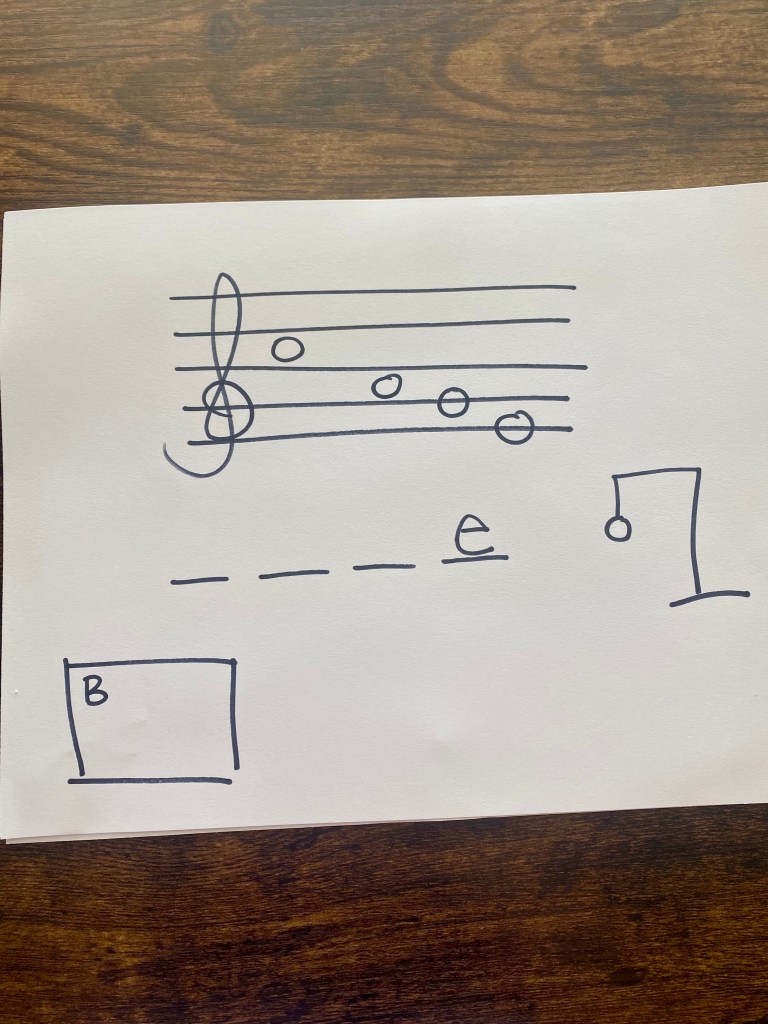
Lastly, reinforcement games can further creativity as well. Reinforcement games help continue what concepts are learned throughout lessons in a fun and creative way. A fun preschool reinforcement game involves Play-Doh. It doesn’t get more creative than that! Another really fun reinforcement game that I like to implement is Staff Hangman. The game is played on a white board or piece of paper and is basically exactly like hangman, except, the word can only be made up of letters from the treble and bass staves. Students must also draw notes on their staff of choice that match the letters of their word.

Piano lessons foster creativity through improvisation, composition, and reinforcement games. Students can learn to express themselves in a productive and structured way through the freedom o9f improvisation. They can also grow in creativity through composition which helps them to push past mistakes and create something they are truly proud of. Games nurture creativity through helping them apply concepts in a fun and engaging way. No matter your child’s creativity level, piano lessons will definitely foster more creativity in them.

Do you want your child to grow in creativity? If so, comment below to sign up for a free informational call to learn more about our studio!

How Piano Helps Kids Develop Determination and Focus

In today’s microwave, TikTok culture, it’s not hard for children to have short attention spans and move from activity to activity very quickly. Many parents wish their children would just stick to something and not give up so easily. It doesn’t have to be that way, though! Piano is more than music — it’s a structured way to build focus, determination and follow through in kids.

Children aren’t just born committed people; they have to develop it through consistent challenges. In today’s instant-gratification world, we need to intentionally train “stick-with-it” skills. Piano lessons offer low-stakes, high-reward challenges every week. Students leave lessons with specific steps to reach their goals and are guided to achieve their goals one challenging and fun step at a time.

Piano trains focus naturally. The very nature of reading music requires sustained attention. Piano is a full body attention trainer. Hands, eyes, ears, and the brain must work together. Through this, children learn to slow down and concentrate on the process, not just the result. Only 10-15 minutes a day of focused practice is more valuable than an hour of multitasking.

Piano lessons normalize making mistakes – and fixing them. I often tell my students that they will most likely make a mistake, but it is in the fixing them and making it right that matters. Piano builds resilience. It teaching children that when they mess up, they don’t stop, but work to figure out what went wrong. Instant-reward activities like video games and YouTube don’t operate this way, and it’s truly a detriment to those who use them since they don’t reward persistence.

The built in structure of weekly piano lessons builds strong habits. After each lesson, students are assigned songs and activities to work on each week. This keeps them on track and in a good rhythm. Students learn to set micro-goals (1 line, 1 page, 1 song, etc.), and how to achieve them step-by-step. When children take regular weekly piano lessons, they’re building executive function skills which translate to homework, sports, family life, and more.

You do not need to have a motivated child to start piano lessons. Actually, motivation comes after a child sees success, not before. The key is the right support system: a patient teacher, a consistent practice routine, and encouraging feedback. The goal as a parent is to start the spark — the rest can be taught.

Learning piano means learning to stick with something that may be challenging, and then be proud of that. If your child could benefit from more focus, follow-through, or self-discipline, piano could be the most joyful way to build it. Want to help your child grow more focused and resilient through music? Comment here to schedule a free information call to learn more about our studio — I’d love to meet your family!

How Piano Lessons Build Confidence in Kids (and Why It Lasts)

Parents often enroll their kids in piano to learn music — but what they gain is so much more. Confidence, self-expression, and a voice that goes beyond words. At Morse Music Academy, we specialize in empowering confidence in our students, which starts in the studio, but continues on throughout their personal lives.

Music is a Whole New Language
In college, I was not required to take a foreign language credit to graduate, unlike most students. This is because I was required to take 4 semesters of music theory—a complete language in itself. In our piano lessons, we ensure that students learn music theory and become musically literate. Therefore, they are actually learning how to read in another language! The joy on a student’s face when they “get it” — the hard concept, the challenging rhythm, the piece they never thought they’d conquer—is truly remarkable. At that moment, more confidence is grown in them.

Music Is Self Expression
Part of learning to play music is also self-expression. I tell my students often that songs are like stories, and you get to tell it in your own way. I always teach students to play songs “as written”, but even then, there is an element of personal freedom. This is shown in the subjectivity of dynamics throughout songs. There is no specific set volume level for “loud” or “very soft”. Students can take liberty in how loud or soft they feel/believe each section needs to be. Additionally, there are many opportunities for improvisation and composition in our lessons. These are completely up to what the student would like to play/write.

Music is Goal-Oriented
I focus on helping students achieve their goals step-by-step. Once a student starts meeting their goals, a domino effect happens. Small wins at the piano create a growth mindset. Once they achieve goal one, they gain more confidence and motivation to complete goal two, and on and on. We all want our children and family members to be continually growing and moving forward in life.

Confidence on the keys spills into school, friendships, and new challenges. Not only are students gaining confidence in piano playing through learning the language, self-expression, and growth mindset, but they are also gaining confidence in their everyday lives. Lessons learned at the piano bench are not just for the piano bench. Oftentimes, piano students become lifelong learners, motivated leaders, and people who show up kind, generous, and confident in society.

Want to help your child grow in confidence through music? Comment below to book a free info session to learn more about our studio!